In a previous post, I discussed the importance of determining what you actually need to get out of a crisis or emergency exercise, including where your people are in their training and experience. I wanted to extend that thought a little and talk about the value of low-intensity exercises.
When I think back on the exercises I’ve been involved in, both as a participant and a facilitator, there has been value in all of them. But, as I discussed last time, that value needs to be weighed against the cost of running the exercise; both the cost of development and the time and commitment required from participants.
If you choose to run a full functional incident management team exercise, with real-time injects, non-playing characters, simulated data and time pressure, supported by a full suite of exercise control staff and role players, the costs can very easily climb into the tens of thousands.
And with good reason.
Scoping the exercise, developing a meaningful scenario and timeline, and crafting realistic situational injects takes many, many hours. Coordinating participants, multiple agencies, role players and exercise control staff takes a lot of logistics and administration. And that is all before the actual exercise. Afterwards, you still have debriefing, evaluation and report writing.
And what does that mean on exercise day?
Perhaps 30 participants in your EOC get a fantastic exercise experience. It may be tough, pressured and emotional, but hopefully they walk out having experienced something reasonably close to what a real response might look and feel like. Great.
Then, 12 months later, perhaps a third of those participants have left the organisation. Others may have stepped away from the response team. Slowly, staff attrition opens the capability gap again, from experienced and proficient responders all the way back to complete newbies.
And unless you work in an organisation with a real appetite for exercising, you’re unlikely to unlock the budget for a large functional exercise every year, let alone several times a year.
So what’s the alternative?
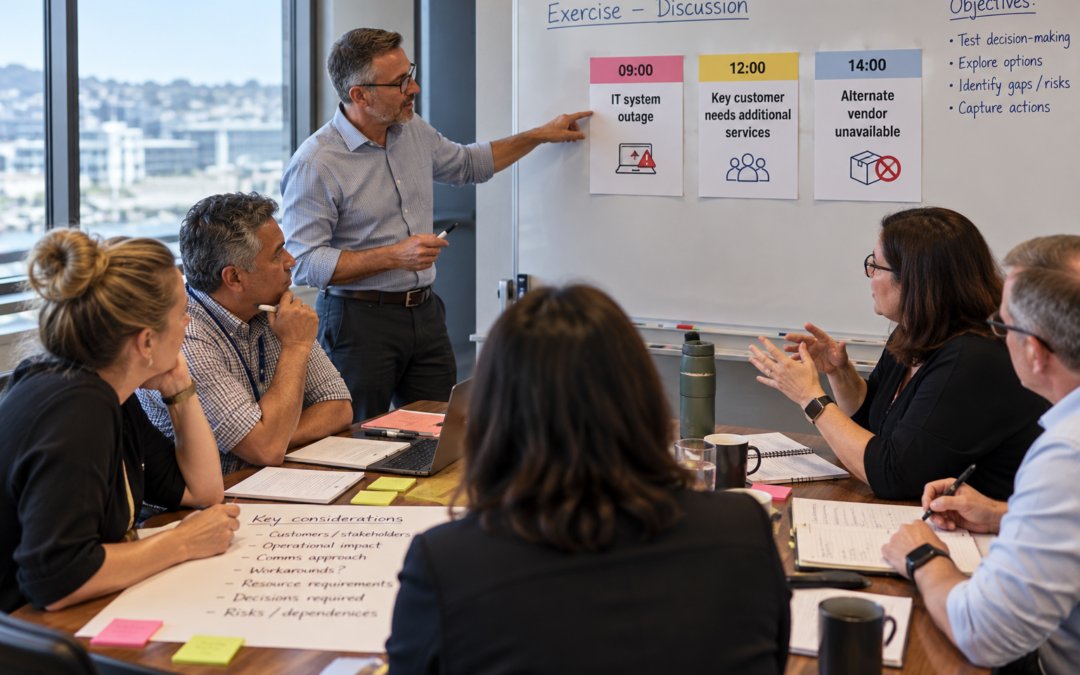
For a corporate crisis management team or a business unit exercising its business continuity plan, particularly where the problems are primarily about information, coordination and decision-making rather than physical operations; a tabletop or discussion exercise may give you far better value.
These exercises require a fraction of the time and effort needed to develop a functional exercise, and for many knowledge-based teams they may be entirely sufficient.
Most business continuity plans are, ultimately, a suite of pre-loaded actions, options and decisions. A good crisis management plan should provide the structure and processes needed to make decisions about events that may never have been anticipated in advance.
So let people practise doing exactly that.
Give them a scenario. Ask them what they would do. Introduce another problem. Challenge their assumptions. Ask who has authority to make the decision, what information they need, who they need to speak to, and what happens next.
A good facilitator can still ask probing questions, test the plan and stretch the participants. The exercise can still tell the story of a situation that challenges the resilience of the organisation. It just doesn’t need an army of role players and an EXCON room to do it.
I’ve previously established exercise programmes where critical business units ran at least two discussion-based exercises each year. They lasted only one or two hours, but gave managers an opportunity to properly think through operational problems and how their teams might respond.
They also provided a much more dynamic way for teams to engage with their continuity plans.
Because, let’s be honest, sitting down and reading a BCP from start to finish can be a little dry.
I remember a business unit manager coming up to me after a real earthquake response and telling me that the short exercises we had run over the previous couple of years had been more valuable than any actual plan.
You’ve probably heard a thousand different sporting analogies about the importance of training and readiness. But think about what those analogies are actually saying. Great athletes are good at what they do because they practise. Then they practise again. And when they are thoroughly bored with practising, they practise some more. That repetition is what makes them good on the day.
The same applies to your incident management team, business unit or coordination centre crew. The more often they practise what they are expected to do, the better they should be when it matters. If their job is to make decisions, have them practise making decisions in crisis scenarios.
And have them do it more than once every year or two. Make it short. Make it relatively painless. Build it into a programme. You could even squeeze a short scenario into a monthly executive or leadership team meeting.
Exercising does not always need the complexity and cost of a space shuttle launch.
Sometimes you just need to get people around a table and give them a problem to solve.
Recent Comments