In the emergency management community, we talk frequently about the importance of situational awareness. About how an Incident Management Team needs to maintain a ‘common operating (or operational) picture’, or COP.
It comes up in exercises, in planning, and certainly in after-action reviews. We talk about COPs in individual Emergency Operations Centres (EOCs), across the various layers of response within large agencies, and especially in multi-agency coordination centres.
So, what exactly is a COP, and why is it so important? More importantly, what does a good one actually look like?
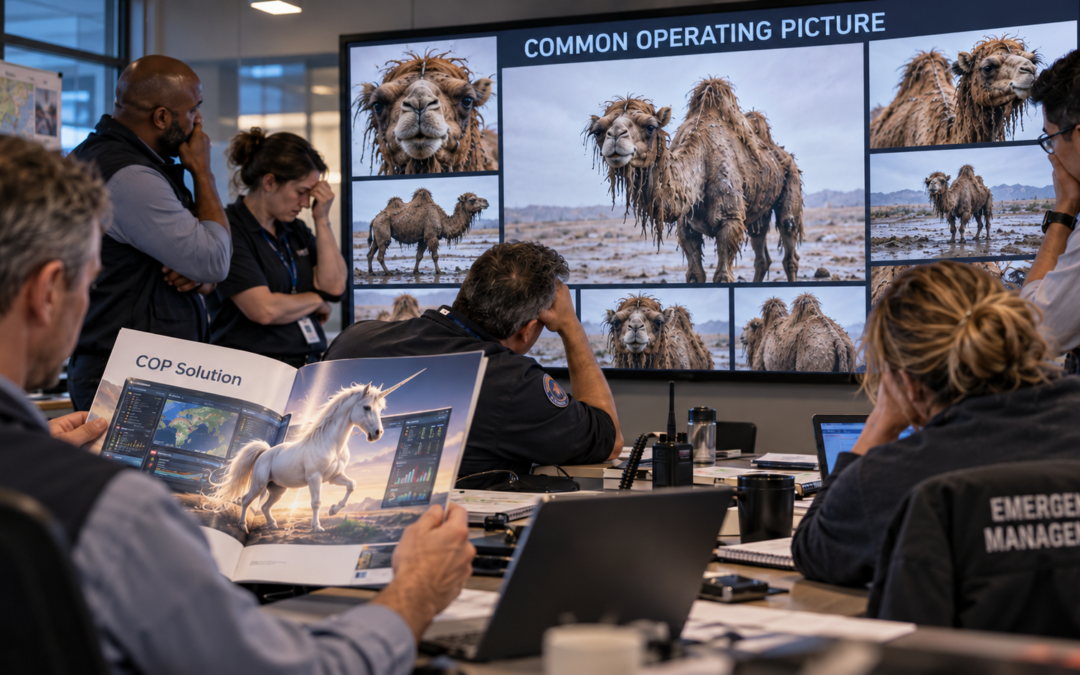
I’ve rarely seen a really good COP. After all these years, I’m beginning to think it might be a unicorn.
The principle is straightforward enough. A display, or series of displays, that establishes a shared understanding of the operational situation. In other words, a single source of truth: a visual representation of the essential information and intelligence that decision makers need, helping to remove barriers to communication and coordination.
We’re talking about lists, traffic-lights, dashboards, status boards, maps, network diagrams and the like. That should be easy enough to achieve, right?
So why does it seem so hard to get right?
The challenge of knowing what you need
The concept of ‘shared understanding’ often gets interpreted as showing everyone the same information about the response. But I think one of the biggest challenges is working out what information you actually need for your operation.
There’s a fundamental tension between the information you want displayed to support decision making and the information that’s available to you. It’s a chicken-and-egg problem. You can’t display information you don’t have, but you can’t collect it if you haven’t worked out what’s needed. You need to anticipate before the emergency (and learn from previous responses) what information will support good decision making. Then you need to design the intelligence processes and ICT capabilities to collect, interpret and present that information. For a single-agency operation with a reasonably well-defined mission, this is a manageable challenge. Not necessarily easy, but manageable.
The multi-agency camel
Things become considerably more complicated in multi-agency coordination centres.
The mission is often harder to define in advance. Different agencies have different responsibilities, priorities, authorities and information requirements. Even defining what needs to be coordinated, let alone how, can be challenging.
And here’s the trap. In trying to develop a common operating picture, we can end up assuming that every agency and operational centre needs to be looking at essentially the same picture. So we start accommodating everyone’s requirements, adding more information, more displays and more functionality.
Before long, we’ve created the proverbial camel: a horse designed by committee.
It might contain everything that everyone asked for, but that doesn’t mean it’s particularly useful to anybody.
Common data, different pictures
I don’t think we necessarily need a common picture.
Each agency, operational centre or layer of response should be making different, albeit interrelated, decisions. An operational level EOC has different information needs from an agency coordination centre, which in turn needs a different perspective from a multi-agency strategic-level coordination group.
The picture should reflect the decisions being made, and the reporting and coordination needs of the people making them.
It’s not the picture that needs to be common. It’s the underlying operational data.
As technology improves our ability to collect, share, store and display information in real time, we should be able to move away from trying to create one picture that suits everyone.
Instead, each agency or coordination centre should be able to draw on a common pool of operational data and present the information most relevant to its own needs.
Of course, common data doesn’t automatically create shared situational awareness. Agencies still need to understand what that information means, how it affects one another, and where their decisions intersect. That’s where coordination and communication remain essential. Seems far more useful than trying to make everyone look at the same dashboard.
Perhaps a truly common operating picture is a unicorn. But rather than designing another camel, maybe we should concentrate on giving each decision maker the horse they actually need.
Recent Comments