
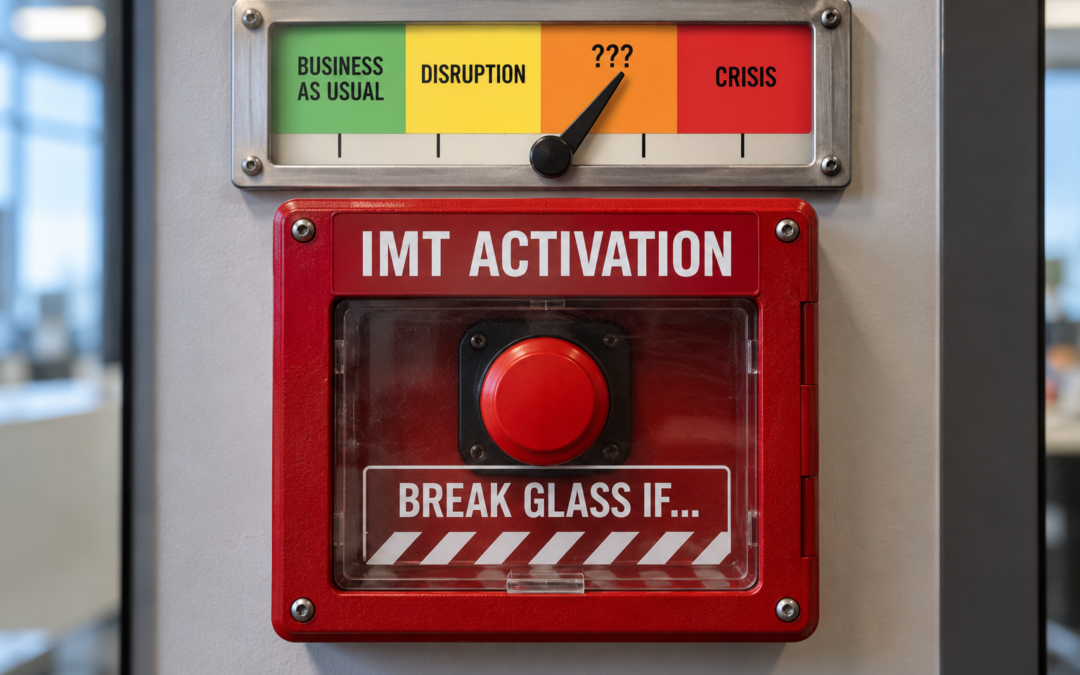
Some people will activate their crisis response at the drop of a hat. Others will approach the situation like it’s just another day at the office. Some will actively resist activating an IMT because they fear some kind of reputational impact. Or maybe they just want to start their weekend.
So when should you activate your crisis response?
Whether you’re a commercial enterprise facing a supply-chain disruption, a small company dealing with a sudden staff shortage, or a city council facing the threat of a natural hazard, activation can be a significant moment for an organisation. It means acknowledging that there is a problem serious enough to step away from business-as-usual and focus specifically on the situation in front of you.
Knowing whether to respond is relatively easy when events are really small or really big. The small stuff clearly doesn’t justify activating your crisis arrangements. The catastrophic stuff clearly does.
It’s everything in between that gets tricky. So what’s the answer?
To move beyond “it depends” or “I’ll know it when I see it”, your plans need to contain some form of triggers or activation criteria. There’s nothing particularly new in that idea. But if you’re writing your first response plan, think carefully about who will actually be turning to that document for advice, and under what circumstances. It will probably be a senior manager of a team, business unit or organisation, potentially dealing with a fast-moving, uncertain and emotionally charged situation. That is not the ideal time to discover that your activation criteria say little more than “when the situation is serious”.
If the triggers are too broad and open to interpretation, they can simply be ignored and provide little useful guidance. Conversely, if they are rigidly black-and-white, there will inevitably be (serious) events that fall outside the rules.
So activation criteria need to sit somewhere in between.
They should provide boundaries for judgement: clear indicators that something may have moved beyond business-as-usual, while still allowing someone to assess the situation in front of them.
That might include the scale or duration of disruption, impacts on critical services, threats to people, increasing uncertainty, loss of normal management capability, significant stakeholder or media interest, or the potential for the situation to escalate.
And importantly, activation doesn’t have to mean going immediately to maximum response. You can bring people together, establish situational awareness and decide that the existing arrangements are sufficient. You can always stand the team down again.
There will always be situations that fall outside your criteria. No plan can anticipate everything. But you won’t find many emergency management professionals who won’t tell you that, if in doubt, activate.
And you don’t have to look too hard through post-incident reviews to find conclusions that the IMT, CMT or EOC should have been activated earlier.
There is usually a relatively small cost to activating, assessing the situation and deciding you don’t need the team. The cost of waiting until you’re certain you need them can be considerably higher.
Recent Comments