Last time I talked about the value of running frequent tabletop or discussion exercises rather than relying on larger, more complex functional exercises. But just in case that sounded a little soft, there is absolutely a place for the big exercises too.
In fact, your teams should be challenged. As they become more capable, the exercises should become harder. The question is when and how quickly you get there.
I also said that athletes become good at what they do through frequent and consistent practice. The same applies to your incident management team: practise often, learn from mistakes, get better.
But before we go anywhere near a fully integrated IMT functional exercise, let’s start smaller and more technical.
Skills training.
Within your IMT, CMT or emergency operations centre, each functional area has different responsibilities and will have its own tools, templates and processes. Please make sure people know how to use them before they go anywhere near an exercise.
Some of this will be straightforward. If people work in an office, they probably know how to use the standard word-processing and spreadsheet tools available to them. But do they know what is expected of them when using those tools during an incident? If you expect your logistics team to maintain a purchasing ledger or inventory control system, they may all know how to use Microsoft Excel. But do they understand what is required in each column and row? If you designed the spreadsheet, you might think it is self-explanatory. If your lead accountant happens to be filling it in, they may find it child’s play. Someone else might be completely lost without some coaching first.
Skills matter.
When I was a volunteer in the emergency services, we used to practise knot tying in a classroom, with the goal of being able to tie particular knots in less than 30 seconds, blindfolded. Why? Because one day you might need to tie that same knot in the middle of the night, in the rain, lying on a roof with your arms hanging over the edge while trying to secure a tarpaulin. We didn’t necessarily need to tie it in 30 seconds on that roof. But imagine how long it would take under those conditions if, in a warm classroom with the lights on and your eyes open, it took five minutes. We trained the basic skill until it became familiar. Then we added height, darkness, weather, fatigue and pressure. Your IMT training should work the same way.
That brings me to functional exercises.
If everyone has been trained and you are ready to run one, come back to that key question: what are you trying to achieve?
Is it about giving the team experience? Do you want them to experience a realistic simulation before they have to deal with the real thing? It probably should be.
But the exercise still needs to be pitched at the right level for the participants. Exercising under pressure has value, but overwhelming inexperienced participants does not.
You’re trying to build resilience. And resilience comes from skills and confidence: confidence that people understand their roles and responsibilities; that they can use the tools and systems; that they understand the hierarchy and concept of operations; and that they know how the operations centre works around them.
They also need confidence that they will be supported by their peers and their leaders. You don’t build that by immediately throwing people into the deep end. Build up to it.
Even a relatively light but well-designed functional exercise will stretch a newly trained, fresh-faced IMT. As the team becomes more experienced, turn up the pressure. Make the problems bigger. Increase the tempo. Introduce cascading continuity problems, incomplete information and competing priorities.
A seasoned IMT should be challenged. If everyone walks out of every exercise thinking it was easy, you probably aren’t stretching them enough.
But there is another part of the sporting analogy worth remembering: training never really finishes. Athletes don’t reach a particular level of competence and then stop practising. Performance goes up and down. People develop at different rates. They have different strengths. They get injured. They change positions. People leave and new people join.
Your IMT is no different. Some people will take naturally to their allocated roles; others won’t. Someone who is excellent in their day job may struggle with the ambiguity and tempo of incident management. Someone else may surprise you.
And your team will keep changing. People move around the organisation, get promoted, change roles or leave altogether. If your IMT has been assembled from people across the business, some will inevitably decide that incident management isn’t for them.
So there is no point at which you can declare the IMT “trained” and move on. Capability needs to be maintained.
That doesn’t mean running a full functional exercise every few months. Apart from anything else, that would be enormously expensive.
A good functional exercise takes significant effort to produce. Someone has to develop the scenario and timeline, create the injects and simulated information, coordinate role players and non-playing characters, build the exercise-control arrangements and then actually run the simulation. If you want the IMT to experience something approaching the complexity and uncertainty of a real event, somebody has to create that world for them.
That takes time and money. Which is why functional exercises should sit within a broader programme rather than be the programme.
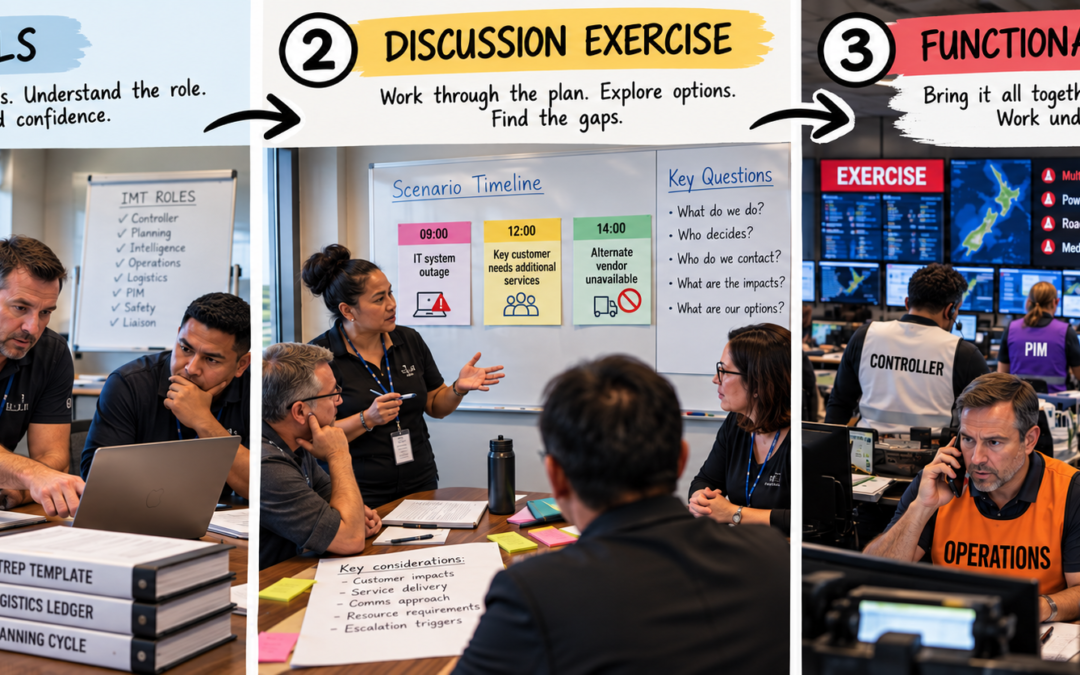
Use skills training to build competence. Use short discussion exercises to practise frequently. Use functional exercises periodically to bring the pieces together and expose the team to greater realism, complexity and pressure.
Then learn from it and start the cycle again.
And don’t forget the other purpose of exercising.
Test the plan.
That might mean a specific plan, framework or SOP. It might be a particular piece of ICT. Or perhaps there is one aspect of your operation that you specifically want to test.
Can your EOC rostering platform actually cope with a sustained response? Can you share geospatial analysis effectively with another EOC? Does your planning cycle work at operational tempo? Does the intelligence process produce information that decision-makers can actually use?
In each case, some of the best evaluation won’t come from exercise umpires standing at the back of the room with clipboards. It will come from the participants themselves. They are the people using the systems, processes and plans under pressure. Give them the opportunity to tell you what worked, what didn’t and what got in their way.
Train. Practise. Exercise. Learn. Then do it again. And make it harder when your people are ready for it.
Exercise the people. Test the plans.
Recent Comments